Count the rooms you have loved people in, and notice what you were holding in each of them. The kitchen, where it was easiest to say it with a meal. The car, where you did the driving. The crisis, where you were somehow always the one with the phone numbers, the plan, the quiet ability to cover whatever was short. Ask the people who love you to describe you and they may reach for verbs of supply: she feeds us, he fixes it, they always come through.
That was the shape of it, in the relationships that mattered — you arrived carrying something. Affection went out of you as provision: cooked, driven, arranged, repaired, paid for without a word. Provision was the dialect you trusted. Words could be doubted; a full table could not. And inside the generosity, so quiet it never had to be said, a second arrangement grew. If you give first, and give enough, nothing can be asked of you. The one who is needed is never the one in need.
This reading does not doubt the love. It asks about the pricing. Being needed and being held can feel almost identical from the inside — both are warm, both are regular, both put you at the centre of somebody's day. The difference shows at the edges. Need calls when something is missing. Holding calls when nothing is.
What the providing may be protecting
As long as love is priced in provision, you can always afford it — you set the price yourself and pay it in advance. That is the arrangement's real gift, and its real cost. It spares you the open question underneath, the one the constant carrying keeps muffled: whether you would be chosen with your hands empty. The provider never has to find out. There is always another meal, another rescue, another way to make the question unnecessary.
One way to read the pattern is as an answer that outlived its question. Somewhere, being useful drew warmth where being present did not, and you took the sensible lesson. It worked — it usually works — and then it kept working long after the room it was built for was gone. Now it runs on its own, and its side effect deserves naming plainly: it teaches everyone around you that your presence comes with catering, and it teaches you that it has to.
The card in the middle
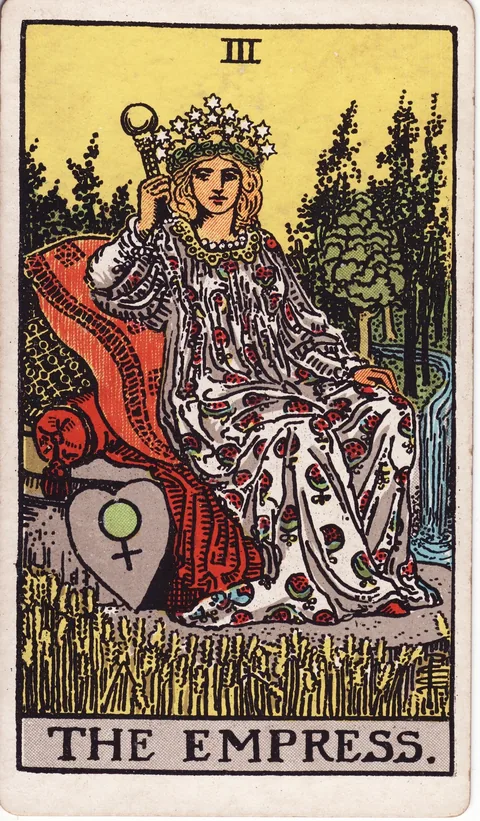
The Empress is the majors' picture of plenty — grain thick at her feet, water moving behind her, everything on the card either growing or about to. Notice where she is drawn, though: seated, cushioned, in the middle of the garden rather than at its gate. The plenty does not stop when she sits down. Turned up as what you accepted, her question is gentle and exact: whose garden feeds you — and when did you last sit in your own?
In your timing
The timing line above carries today’s sun and moon. In any season that rewards service — and most find a way to — providing can pass for personality, so read the moon as the honest gauge here: waxing, it favours what grows untended; waning, it permits a role to rest. Either way, the table can survive an evening you did not set.
One empty-handed hour
Once this week, arrive empty-handed on purpose — no food, no fix, no plan for anyone else's evening — and stay the whole visit without correcting it. Notice the moment your hands start looking for a job: the dishes, the problem, the errand. You do not have to stop them every time. Just notice that the urge arrives before any need does, which says something about whose need it was serving.
And if, some evening, someone does a small thing for you — pours, carries, cooks the simple thing badly and brings it anyway — let it land without matching it. What you feel in that minute is, symbolically, the exchange-rate this reading came to show you: the price you have been quoting for your presence, and the evidence, sitting right there, that nobody else set it that high.