Think of the last gift that unsettled you. Not an extravagant one — just slightly more than you would have spent, or given at a moment you had not marked, so there was nothing on your side to set against it. You said thank you beautifully. And then, for a day or a week, some back room of you stayed open late, working out what would even it — until the return was made, the account closed, and you could like the person comfortably again.
That is the posture: love as double-entry. Who called last, who drove last time, who apologised first and how often. The favour repaid before it had finished being a favour; the kindness answered so quickly it never got to sit in the room; the apology produced on schedule, traded across the table like a settlement rather than felt. Nobody taught you this out loud. You ran the numbers under the table, mid-hug, mid-holiday — and the people around you would probably call you generous, because a careful bookkeeper's accounts always look generous from outside. Only you know the entries were defensive.
Fairness is a real virtue, and this reading does not pretend otherwise. But notice what the balancing buys you, every single time: a clean exit. Nothing owed in either direction means nobody can call anything in. You are never at anyone's mercy, and no one is ever at yours. The books close nightly. So does something else.
What the arithmetic may be protecting
Being owed is a risk — the debt may never be honoured, and the disappointment lands on you. Owing is worse: it places your standing in someone's hands and asks you to live there, unresolved, until they decide what to do with it. The rapid repayment shields you from both. What it costs is quieter and takes years to show. An even ledger is a finished story. Debts, in the soft sense — the unreturned kindness, the apology accepted and never invoiced, the help both of you know cannot be evened — are what keep two people walking back toward each other. Intimacy runs on open balances. You have been closing them, promptly, politely, for as long as you can remember, and then wondering at the faint draught of doors clicking shut.
The card in the middle
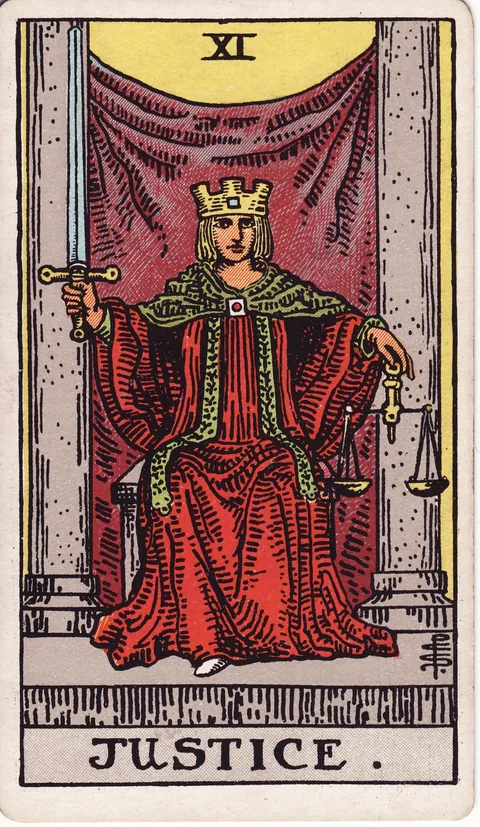
Justice is a public card — the level scales, the upright sword, the gaze that comes straight out of the picture at you. In a courtroom, in a contract, at a border, this is exactly who you want on the bench. Turned up as what you accepted, the image reads differently: the bench has moved into the house. The scales are exact and impartial, and they weigh whatever is set on them without warmth, because weighing is their whole vocation. The card does not tell you to abandon fairness. It asks where you installed it.
In your timing
The scales on this card have a month of their own on the wheel — when the sun crosses Libra, the tallying reflex sharpens everywhere, and the timing line above will tell you if you are in it. The practice below needs no calendar, though: any week can be the one that leaves a pan deliberately heavier.
One debt to leave standing
This week, when something small arrives from someone you love — a coffee, a lift, an unprompted kindness — receive it and do not even it. No return gesture within the day, no "I owe you", no mental note filed for the weekend. Let it stand for seven days as an open balance, and watch what the open balance does: to them, who may come back toward it, and to you, who may discover that being slightly in debt to a person is one of the textures of being close to them.
If a week feels impossible, notice that too — the size of the discomfort is the size of the armour. What you were owed, all along, was the experience the arithmetic kept refunding: someone glad to have you owing, and in no hurry at all to collect.