People arrive at you the way documents arrive at a border. You are gracious about it — most travellers never notice the inspection — but nothing gets through unread. The new colleague, the promising date, the friend of a friend at dinner: each is scanned for intent, weighed for reliability, filed under a provisional stamp. And the traffic runs both ways. What leaves you is redacted with the same care — the true answer swapped for the safe one, the difficult week summarised as "busy", the telling detail held back until it can be phrased to tell less.
Call it discernment, because that is what it was at the start. Someone got in once who should not have, or watched you too closely, or repeated the thing you said in the wrong room — and the door learned. There is nothing foolish in a checkpoint. Vetting is what intelligent trust looks like while it works. The trouble is quieter, and structural: somewhere along the way the examining stopped being the door's function and became its condition. Nothing enters unexamined. Which has come to mean, on the slow nights you prefer not to dwell on, that almost nothing enters.
You accepted the door as yours to guard — both directions, all hours, no relief shift. It is skilled work, and you are genuinely good at it. This reading only asks what the post has cost the keeper.
What the checkpoint may be protecting
Officially: the interior. What you hold is real and has been mishandled before, so the vetting protects the archive — the tender material, the history, the versions of you that exist nowhere else. But a checkpoint maintained this long may also be protecting a belief so old it no longer reads as a belief at all: that what you are must be pre-screened to be safe in company, and pre-approved to be worth it. Discernment guards the treasure. Somewhere underneath, it may also be guarding the suspicion that unvetted — unphrased, caught mid-week and mid-mess — you would not pass your own inspection.
The card in the middle
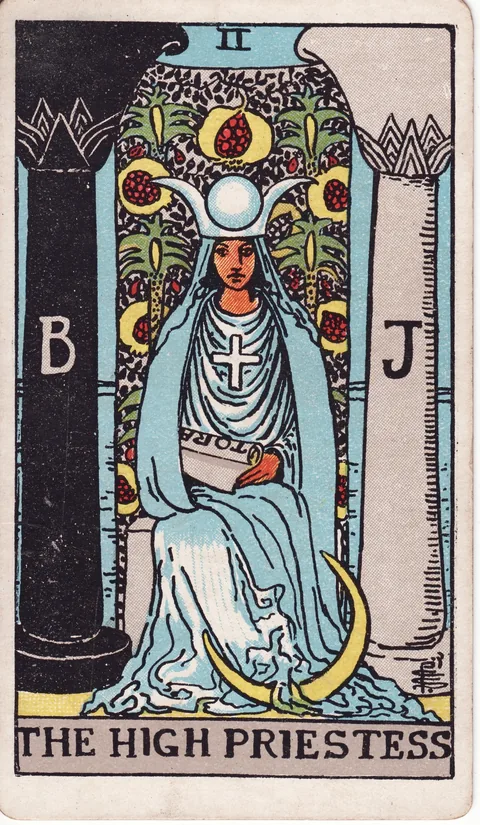
The High Priestess sits precisely where you sit: on the threshold, between the two pillars, the scroll in her lap only partly open, the veil hung close behind her with water just visible at its edge. Everything in the picture promises depth and grants none of it yet. One way to read her, in this position, is as the door's patron and its warning at once — a threshold exists so that crossing can happen, and a veil that is never lifted for anyone stops being a veil. It becomes the back wall.
In your timing
Her card carries a crescent at the hem, so take the timing by moonlight: through a waxing fortnight, what has been sealed tends to strain gently toward disclosure. Symbolically it is a season that favours the small opening over the grand reveal — an inch of veil, not the whole rail.
One thing to let through unread
Once this week, let something cross the threshold unvetted. When someone you have already decided to trust asks how you are, give the first true answer instead of the second, phrased one — the answer you had before you inspected it. Or hand over one uncurated fact about your week before working out what it says about you. Small openings only; the door stays on its hinges.
Then stand inside for a moment and consider the difference between a door and a wall from where you live. A wall is finished. A door is a claim — that something in here is worth crossing to, and that the crossing is allowed. What you were owed, through all those years at the checkpoint, was traffic: to be read in your own hand, not in your press release. The guarding was never the problem. It was the only currency you were letting love pay you in.