A tarot deck spends three of its four suits on the invisible. Cups carry feeling, swords carry thought, wands carry appetite — and then there is Pentacles, the suit that lands. In many decks it is simply called Coins: round, stamped, spendable. This is the suit of the material — money and work, but also the body, the house, the garden, everything that has to be paid for, maintained or carried up the stairs. When a money question is on the table and a pentacle turns over, the deck has stopped speaking in metaphor and begun speaking in your first language.
This page holds the whole suit, read for money first. If you drew one card, its entry is an anchor away. If a single pentacle keeps appearing for you — across readings, apps, shop windows — read its entry and then its two neighbours, because a card that follows you around is usually mid-sentence. And if you are learning the deck, the suit reads straight through, Ace to King: fourteen postures a person can hold toward the material — a complete money vocabulary.
The frame, before the first coin. The pictures described here are Pamela Colman Smith’s, drawn for the deck published in 1909 that most new readers now meet first; the readings are the ones in common modern use, and where readers genuinely part ways — reversals, the court cards — this page says so instead of smoothing the disagreement over. None of it is prediction. A card cannot move money, hire anyone or settle a debt. What it can do is show you the posture you are already holding toward the material — and a posture, once seen, can be adjusted by the ordinary human method: on purpose.
Reading a pentacle when it appears
Start with what the figure is doing with the coin. Every card in this suit shows somebody handling the material — offering it, juggling it, carving it, gripping it, weighing it out, growing it, wearing it — and the money reading starts there. Then ask two questions: where in my money life am I making that exact gesture, and is the gesture serving me right now, or has it hardened into habit? The first question locates the card. The second finds its edge.
Each entry below gives a daylight face and a shadow — not a good and a bad outcome, but the same gesture at the right and the wrong dose. Readers differ on reversals, honestly: some take an upside-down pentacle as the shadow made loud, while others never reverse at all and let the neighbouring cards decide. Both habits work with this page. And each entry ends with something small and concrete, because a coin card that changes nothing about your week was only ever card stock.
Ace through Ten
Ace of Pentacles — the offered coin
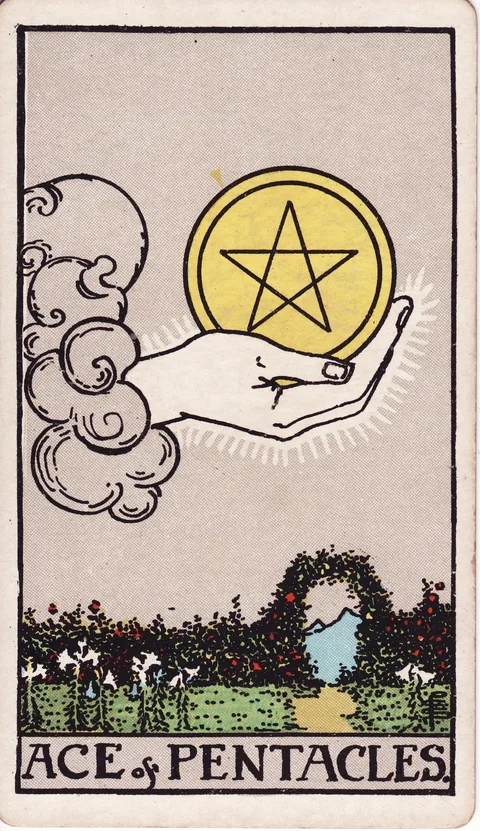
A hand out of a cloud holds one coin above a garden with an arched gate. In a money reading the Ace is a material beginning: an offer, an opening, a first payment, a plot of actual ground — the seed of something that could keep paying if it were planted and left in the earth. It is not the harvest — and an Ace treated as a windfall gets spent as one, so the garden never happens. The coin fits in one hand so that a hand can plant it. Its shadow is the wait for a worthier seed — the offer dismissed as beneath you, the modest commission declined while you hold out for the version that would feel like being chosen. When the Ace appears, name the opening on your table that you have been calling too small, and ask what it might grow into if accepted.
Two of Pentacles — kept airborne
A figure dances on one foot, juggling two coins bound in a loop of ribbon, ships climbing waves behind. This is cash flow as choreography — two obligations kept aloft, the invoice timed against the rent, the second job balanced on the first. The Two tends to appear when the juggle is genuinely working, and it honours the skill involved: a fair amount of solvency is simply very good timing, sustained. Its shadow arrives when balancing becomes the identity. Nothing juggled is ever set down long enough to grow, motion starts answering questions nobody asked of it, and busy-ness stands in for progress while the ships behind carry someone else’s cargo. A useful test when the Two shows up: say aloud which of the two things you are keeping airborne you would set down first, if you trusted it not to shatter. The answer is rarely a surprise. The hesitation before the answer is the reading.
Three of Pentacles — craft, witnessed
Inside a church doorway, a young stoneworker pauses on a bench while two robed figures hold up the plans. The Three is craft meeting recognition: skilled work witnessed, commissioned and paid for — often the first time somebody puts real money behind what you can do. Read for money it points at collaboration, the earning that happens when your competence becomes visible to people who hold budgets, and it can mark the moment a sideline becomes a trade. Its shadow splits in two directions. One is working for the applause instead of the standard, letting the audience set the specification. The other is refusing the cathedral altogether — craft kept private because shared credit feels like theft. A check that costs nothing: recall the last time you were paid for your best work rather than your fastest, and how long ago that was. The distance between those two dates is a reasonable map of what to sell more of.
Four of Pentacles — the grip
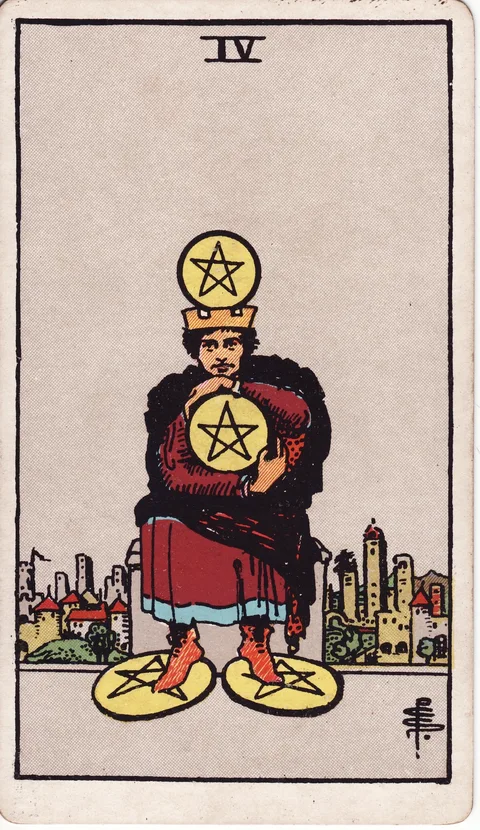
A crowned figure sits with one coin clutched to his chest, one under each foot, one balanced on his head. In a money reading the Four is the first card of having something to lose, and its daylight face is legitimate: boundaries, reserves, the word no, security built and then defended. Savings are not a character flaw. The shadow is the posture itself — look at him: he cannot walk, work or embrace anyone without dropping something. One way to read the grip is as a memory of the year the money ran out, still giving orders long after the danger passed. The deeper version of this pattern — money moved out of sight before it can be seen, the hoard and the leak as two doors out of the same fear — is read at full length in the essay on why money leaves. When the Four turns up, try this once: name aloud what the holding protects. Not the amount — the thing underneath the amount.
The wall · The VaultWhen holding on is the blockFive of Pentacles — snow beside a lit window
Two figures move through snow past a lit stained-glass window, one on crutches, neither looking up. The Five is the lean season — the reading nobody wants and nearly everybody eventually gets: loss, shortfall, the stretch where the material stops being an idea. But look at where the light is. The window is right beside them, the sanctuary presumably has a door, and the card’s sharpest question is not why is it snowing but why is nobody looking up. In money terms the Five often describes hardship endured one season past the point where help was available — pride wearing endurance’s coat, the request never made because asking would make the trouble official. The detail that gives this card away in an ordinary week is the help you have already decided not to ask for. Name who is behind the window. Then decide again — this time on purpose.
Six of Pentacles — scales in one hand
A merchant in a red robe weighs coins in a hand-held scale and gives with the other hand; two figures kneel to receive. Money is moving in this card, and moving generously — the raise granted, the debt forgiven, the patron found, the tip that means someone noticed. Read for money the Six is about exchange with a height difference, and its first question is positional: in this scene, are you standing or kneeling — and which of the two postures have you come to find more comfortable? Generosity is the daylight face, and it is real. The shadow — the giver who is only at ease while money is moving away from them, the scales tipped permanently in one direction — is the pattern why money leaves as fast as it arrives examines closely. One small count: of the last five money exchanges you can remember, how many found you on the standing side? Five out of five is not virtue. It may be a fixed position.
Seven of Pentacles — the long look at the vine
A labourer leans on a hoe, chin on his hands, studying seven coins growing on a vine. Nothing in this card is being earned right now, and that is its subject: the pause between work and harvest, the season when money grows where you cannot see it and the only honest verb is wait. Read for money the Seven blesses assessment — the stepped-back look at whether the thing you built is actually compounding. Its shadow is the permanent lean: evaluation that never ends in a decision, a pause stretched into a residence, tiredness dressed up as discernment. There is a version of this figure who is not assessing the vine at all, only avoiding the next row. The Seven’s homework is one evening with a list: everything you are tending, sorted into still growing and finished long ago. The second column is the news — something on it has been holding a place in your week that the harvest left years back, and that is worth sitting with before the next planting.
Eight of Pentacles — the workbench
A craftsman at a bench carves the same pentacle for the eighth time, six hung up, one waiting. This is the money of skill in repetition — the rate that rises because the work got better, the practice hours that quietly reprice everything you sell afterwards. Read for money the Eight is the most reassuring card in the suit: it describes earning you can influence directly, coin by coin, without permission from luck. Its shadow is the bench as hiding place. Head down is a comfortable posture, and it can outlast its usefulness — the ninth coin polished while the invoice for the first six goes unsent, mastery pursued one degree past what any buyer could perceive, diligence standing in for the pricing conversation that actually frightens you. Spend one working day watching your own hands. How much of what they do is craft, and how much is re-polishing something that was already good enough to bill? The Eight approves of the first without limit. The second it calls what it is: shelter.
Nine of Pentacles — a garden of one’s own
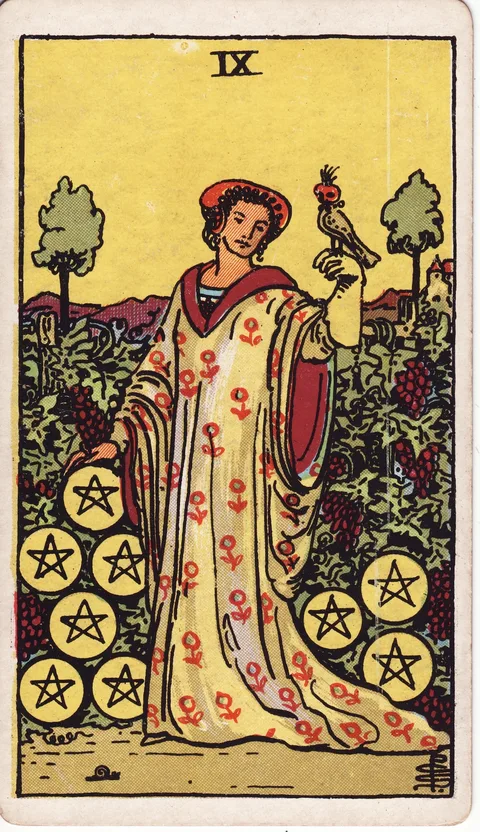
A woman stands alone in a loaded vineyard, a hooded falcon on her glove, the estate hers. The Nine is material independence — comfort that answers to nobody, the account that makes no and not yet sayable, discipline matured into ease. In a money reading it often marks self-funded ground: the reserve that ended the emergencies, the paid-off thing, the price of your own company found reasonable. Read the falcon closely — that is trained appetite, hunger under a hood, restraint chosen rather than absent. The shadow is the wall at the garden’s edge. Independence can calcify into a refusal to be contributed to; the solitude that built the vineyard stays on past its shift and starts declining company, partnership, help with the harvest. A quiet audit, when this card appears: which of your comforts do you own outright, and which are still mortgaged to somebody’s approval? The garden is only finished when you can invite someone in.
Ten of Pentacles — the gate and the household
Three generations, two dogs, an archway, coins laid over the scene like a constellation — and one old man at the edge whom nobody appears to see. The Ten is money at household scale: property, legacy, the family arrangement, wealth as a system rather than a number with your name on it. Read for money it asks the largest question in the suit — what is all of it for — and answers with a picture: a gate people can walk through. Its shadow is the weight of the very inheritance it celebrates — the standards, silences and obligations that arrive bundled with family money, territory the long money essay walks slowly and this page leaves to it. The other shadow is the founder faded to the margin of his own courtyard, the builder invisible inside the built thing. When the Ten appears, pick one money rule you inherited rather than chose — a standard, a silence, a house habit — and ask whether you would adopt it today, from a stranger.
The court: Page, Knight, Queen, King
The four court cards are the suit grown into people — or into postures, depending on your school. Some readers cast them as actual persons in your life; others read them as stages of your own relationship with the material; and where an older habit matched Queens to women and Kings to men, many contemporary readers let the roles float free of anybody’s gender. This page reads them as postures you can occupy at any age, in any body.
Page of Pentacles — student of the coin
A young figure in a green field holds a single coin up to eye level, studying it like the first interesting object on earth. The Page is the student posture: the first wage, the new skill, a small sum handled with enormous attention. In money questions it often points to an apprenticeship worth taking — the course, the mentor, the modest gig that teaches the trade — and it dignifies smallness: nobody else in the deck looks at one coin this carefully. The shadow is the eternal student. Learning is the most respectable place to hide from earning ever built, and a Page gone wrong collects preparation the way the Four collects coins — one more certificate, one more book, one more practice project before the first real invoice. Keep an eye, this month, on the ratio between hours spent learning and hours spent billing, asking or shipping. The Page’s coin is for studying. It is also, eventually, for spending.
Knight of Pentacles — row by row
The stillest horse in the deck stands in a ploughed field, its rider holding a coin and looking at the work, not the horizon. The Knight is money made slowly on purpose: the salary, the standing order, the field done row by row, the compounding that only functions if nobody exciting touches it. Nothing about this card performs, and that is its value — in a money reading it usually endorses the unglamorous mechanism you already own and have been thinking of abandoning for something shinier. Money made this way tends to stay made. The shadow is the rut the wheel cut: method calcified, the same route ploughed years after the field changed, loyalty to a routine that has quietly stopped paying for its seat. So put a date on it: choose one financial arrangement you have not re-examined since the day you set it up, and give it thirty minutes on the calendar. Keep it if it survives the look. Most survive. One usually does not.
Queen of Pentacles — warmth, costed
She sits in a bower of roses, the coin held in her lap, a hare running at her feet. The Queen is material care: money as warmth made practical. The fed household, the mended thing, the resourcefulness that turns a modest sum into an abundant table — earning and spending in service of aliveness, and a household run in this posture rarely feels poor even when the numbers argue. The shadow is a ledger with one omission: her. Everyone provided for except the provider; the care itself costed at nothing because no invoice was ever raised for it; a family economy balancing, year after year, on labour recorded nowhere. This week, notice what you provide that appears in no ledger anywhere — the driving, the managing, the remembering, the cooking that would cost real money from strangers. You do not have to bill anyone for it. You do have to see it, because what goes unseen goes unthanked, and what goes unthanked eventually goes.
King of Pentacles — vines in the robe
He sits among vines that have grown into his robe, one hand resting on the coin the way you rest a hand on a dog that no longer needs holding. The King is the suit finished: stewardship at full scale, wealth worn quietly, the touch that steadies money in a room simply by being in it. In a reading about money he often stands for the version of you the whole suit has been building toward — resourced, unhurried, generous from surplus rather than from fear. His shadow is what mastery becomes when it forgets to stop: control dressed as stewardship, the golden touch that cannot put anything down, a person asking the balance sheet a question about their own worth that no balance sheet can answer. Kings in trouble do not look troubled; they look busy. Before the month closes, find one money decision you are still holding that someone else could hold competently — and hand it over, once, watching what the grip does. What the King protects by gripping is rarely the money. It is usually the throne.
Then find your wall · 3 minutesThe Block ReadingFourteen entries describe the suit’s weather. Three cards, drawn for you, can name yours — the pattern behind the balance, and what opens it.Draw your three cardsReading the suit as a whole
Laid out Ace to Ten, the pip cards make one continuous story. A seed is offered; a balance is kept; a craft is witnessed. The first real money gets held too tightly, is lost anyway, and is given back. Then patience, then work, then independence, then legacy — seed to gate, one coin’s biography. Every money life runs some stretch of this road more than once, and the card you drew mostly names the mile you are standing on — the suit forgives easily: the Five is followed by the Six on the road as reliably as on the page. The courts, read this way, are four paces a person can walk it at — studying the coin, ploughing with it, tending with it, presiding over it.
A spread heavy with pentacles is a reading with both feet on the ground. Whatever you asked — love, timing, the move, the ex — the deck is answering about the material: the money, the work, the body, the lease. The tempo of such a reading is seasons rather than sparks, and its advice is almost always structural before it is emotional. A money spread with no pentacles at all says something just as useful: the question is not yet material. It is still being carried by feeling, thought or appetite, and the account is downstream. Either way, the suit rewards being consulted deliberately rather than waited for — a three-card money spread you can read for yourself gives it three positions to speak from at your own table.
Put the suit to work · TarotA three-card money spread you can read for yourselfThen let the page go and keep one question. Whichever entry argued with you — the grip you recognised, the window you have not been looking up at, the ledger with the missing line — its small assignment is yours for the month; run it once and see what comes back. Nothing here foretells. A habit watched while it happens rarely survives the watching unchanged, and the watching is the entire method. And if the shadow you recognised feels less like a habit than a wall — something standing between you and what you keep asking for — the Block Reading exists to name that wall, one card at a time. The suit of Pentacles keeps the accounts. What happens at the table they are kept on stays, as ever, entirely yours.